***½
I'd have to say The Tempest is one one of Shakespeare's lesser works. Ultimately a comedy (because it's not a tragedy, and technically there's only the two), it amounts to a Shakespeare fluff piece; it's more interested in amusing than in moving. It still has Shakespeare's signature rhythm-based, beautiful dialogue, however, and ironically, contains one of his best, most beautiful, most insightful lines. After conjuring then dismissing a fanciful pageant of spirits, Prospera (the infallible Helen Mirren) begins to wax poetic about the nature of life. "We are such stuff as dreams are made on," she says, "and our little life, is rounded with a sleep." Wonderful.
Unfortunately, (I hesitate to use the word, but will anyway) visionary director Julie Taymor didn't seem to notice the ultimately frivolous nature of this work, and presents it here in very dramatic fashion. Best known for her Broadway work ("The Lion King", the much-troubled "Spider-man: Turn Off the Dark") Taymor has found some success with her Golden Globe and Oscar nominated films, Beatles musical Across the Universe and painter Frida Kahlo biopic Frida, but her first film, the Anthony Hopkins starring and also Shakespeare written Titus, remains her best. Presented with the same drama and visual flair she goes with here, Titus was profoundly moving, deeply disturbing, and visually stunning, with at least two images that have remained with me down through the 12 or so years since I saw it. The style fit that film like a glove. Not so here. The lighter elements often seem drowned by a heavy hand; moments that might have been funny are sometimes lost in translation. As a whole I think the film would have benefited from a lighter touch, and Taymor, who (admirably) always strives for the heights, just doesn't have it in her to tone it down.
But don't get me wrong, the movie's not bad. Taymor even succeeds with some of the more fantastical moments. When Prospera sends her spirit servant Ariel (Ben Wishaw) to torment her usurpers in the guise of a harpy, it appears as a large, black, winged, feathered, crouching monstrosity (featured in the top panel of the poster above) that distorts the very air around it and summons forth ravens with flaps of it's wings. It's the best image in the movie. And Ariel itself is quite a creation: sexless, it appears sometimes with the narrow, flat chest of a young man, and sometimes with small breasts (hence the PG-13 rating), and it divides into multiple pieces as it runs, flies, swims, crawls around the island. The cast (featuring Chris Cooper, Alan Cumming, Russell Brand, Djimon Hounsou, Alfred Molina, and David Straithairn) is mostly very good. Dame Mirren is of course superb, though I'd say Brand over does it a bit (not surprising, honestly), and Hounsou spends so much of his screen time either growling or whining it, combined with his thick accent, makes the fair majority of his lines indecipherable. There's no denying however that he, as Prospera's slave Caliban, creates quite a physical presence, in both the mannered, crouching body language he uses and in the bizarre but fascinating make-up he wears. Finally, the decision to change the sex of the main character (originally Prospero) is inspired, not just because it allowed the casting of Mirren, but also because of the way it alters the dynamic with her daughter (Felicity Jones). As a mother trying to secure a hopeful future for her daughter, Prospera becomes a deeper character than Prospero ever could have been.
I'm a movie lover, and this is my space to talk about movies. Mostly I'll have reviews, sometimes I'll have essays, sometimes I'll have lists. You want to know my opinion. You know you do.
Saturday, January 28, 2012
Wednesday, January 18, 2012
"Attack the Block"
****½
It's Guy Fawkes Day in South London, fireworks are going off in the air, and a young nurse named Sam (Jodie Whittaker) is on her way home on the increasingly dangerous streets of South London. Suddenly a group of thugs appears before her, their heads hooded, their faces masked, She knows where this is going, and so do we. A knife comes out, a brief struggle over a ring, when suddenly something crashes into the car next to the group, giving Sam her chance to escape. Then the movie does a most surprising thing: it let's Sam go and stays with the thugs. They investigate the car and find more than they bargained for. Injured by this whatever-it-is, the gang's leader Moses (John Boyega), swears vengeance. The gang follows the thing as it seeks shelter in a shed, where they corner it, scare it with fireworks, and beat it to death. Moses and his crew know what they've got here, and they carry it back to their block (read "project") as a trophy, visions of wealth and fame taking shape in their heads. Big mistake, for you see that was just the first thing to fall from the sky that night.
First time writer/director Joe Cornish has fashioned an unusual, sometimes hilarious, sometimes scary, often inventive sci-fi horror comedy. Yet he's done something more: buried within this silly monster-a-thon is some very pointed social/racial commentary. It doesn't preach, however. You can easily glide along the surface of this one and have a good time, never noticing the meaning in its depths. We get glimpses into the lives of the protagonists, the thugs that mugged a woman at knife-point in the beginning, but the movie never really tries to make you sympathize with them, never creates excuses for their behaviour. The characters themselves sometimes try to make excuses, but the movie won't let them. And suddenly the find themselves pursued by some big, bad, black beasties. The creature design here is wonderful in that it's so hard to pin down. Roughly gorilla shaped with rows upon rows of luminescent teeth (first shown in a brilliant reveal), the monsters are covered in deep, inky black...something. It might be spiky fur, it might be scaly spikes. I can't tell. You even see them quite clearly and fully in bright light...but I still can't quite nail their form or texture. Other than the form and the teeth, their just like a void of blackness. "It's so black you can hardly see it," one of the characters says. Indeed. And don't think this blackness is just an element of good monster design. It's no accident that the thugs suddenly have to fear black things in the night.
I must make mention of an incredible performance from newcomer John Boyega. His Moses is stoic and quiet, but authoritative, with a sense that there is some rage brimming underneath that steadily calm exterior, and, surprising in such an ultimately unsympathetic character, a sense of nobility and bravery. It's easy to see him as a leader. All the rest of the cast is good as well, especially Whittaker (who we see again of course, a nurse soon becomes a valuable commodity), Luke Treadaway as a stoner/zoologist who happens to get caught up in the fray (and offers his opinions on what the creatures are and what their motives might be), and Nick Frost (Hot Fuzz, Shaun of the Dead, Paul) as the resident drug dealer. I must also mention the movie lost out on five stars only because there was so much London street jargon spoken in such thick accents that there were sometimes long stretches of dialogue I couldn't follow. Context helped sometimes, but not always. Subtitles might have helped more. Ultimately, though, the ride is lots fun, the characters and monsters are fascinating, the rise of its antihero is compelling, and its deeper messages and desire to make you look at yourself shine through if your looking for them, but don't overwhelm if your not. It comes at you like a beast in the night. As Moses would say, "Allow it."
It's Guy Fawkes Day in South London, fireworks are going off in the air, and a young nurse named Sam (Jodie Whittaker) is on her way home on the increasingly dangerous streets of South London. Suddenly a group of thugs appears before her, their heads hooded, their faces masked, She knows where this is going, and so do we. A knife comes out, a brief struggle over a ring, when suddenly something crashes into the car next to the group, giving Sam her chance to escape. Then the movie does a most surprising thing: it let's Sam go and stays with the thugs. They investigate the car and find more than they bargained for. Injured by this whatever-it-is, the gang's leader Moses (John Boyega), swears vengeance. The gang follows the thing as it seeks shelter in a shed, where they corner it, scare it with fireworks, and beat it to death. Moses and his crew know what they've got here, and they carry it back to their block (read "project") as a trophy, visions of wealth and fame taking shape in their heads. Big mistake, for you see that was just the first thing to fall from the sky that night.
First time writer/director Joe Cornish has fashioned an unusual, sometimes hilarious, sometimes scary, often inventive sci-fi horror comedy. Yet he's done something more: buried within this silly monster-a-thon is some very pointed social/racial commentary. It doesn't preach, however. You can easily glide along the surface of this one and have a good time, never noticing the meaning in its depths. We get glimpses into the lives of the protagonists, the thugs that mugged a woman at knife-point in the beginning, but the movie never really tries to make you sympathize with them, never creates excuses for their behaviour. The characters themselves sometimes try to make excuses, but the movie won't let them. And suddenly the find themselves pursued by some big, bad, black beasties. The creature design here is wonderful in that it's so hard to pin down. Roughly gorilla shaped with rows upon rows of luminescent teeth (first shown in a brilliant reveal), the monsters are covered in deep, inky black...something. It might be spiky fur, it might be scaly spikes. I can't tell. You even see them quite clearly and fully in bright light...but I still can't quite nail their form or texture. Other than the form and the teeth, their just like a void of blackness. "It's so black you can hardly see it," one of the characters says. Indeed. And don't think this blackness is just an element of good monster design. It's no accident that the thugs suddenly have to fear black things in the night.
I must make mention of an incredible performance from newcomer John Boyega. His Moses is stoic and quiet, but authoritative, with a sense that there is some rage brimming underneath that steadily calm exterior, and, surprising in such an ultimately unsympathetic character, a sense of nobility and bravery. It's easy to see him as a leader. All the rest of the cast is good as well, especially Whittaker (who we see again of course, a nurse soon becomes a valuable commodity), Luke Treadaway as a stoner/zoologist who happens to get caught up in the fray (and offers his opinions on what the creatures are and what their motives might be), and Nick Frost (Hot Fuzz, Shaun of the Dead, Paul) as the resident drug dealer. I must also mention the movie lost out on five stars only because there was so much London street jargon spoken in such thick accents that there were sometimes long stretches of dialogue I couldn't follow. Context helped sometimes, but not always. Subtitles might have helped more. Ultimately, though, the ride is lots fun, the characters and monsters are fascinating, the rise of its antihero is compelling, and its deeper messages and desire to make you look at yourself shine through if your looking for them, but don't overwhelm if your not. It comes at you like a beast in the night. As Moses would say, "Allow it."
Tuesday, January 17, 2012
"Buck"
*****
"If there was anything in real life like a horse whisperer, it would be Buck." Indeed Buck Brannaman was even an advisor on Robert Redford's film, and informed the character as Redford played him. Redford appears in this documentary, and says so himself, so I have it on good authority. He doesn't whisper to the horses of course, not really. But he seems to have an innate understanding of them, of how they think and function and perceive the world around them, and of how to work with them. He doesn't believe a horse should be broken. He understands that we're asking the horse to do some pretty strange things, comically suggesting you put yourself in the horse's place. "Let me throw some dead animal carcasses on your back," he says, " then let me put this bar in your teeth and pull back on it. It'll only hurt a minute."
Buck is a simple, elegant documentary from director Cindy Meehl that shines a light on a singular human personality. Buck Brannaman tours the country half the year, giving clinics on horse training, sometimes accompanied by his wife and daughter and his wife's plethora of dogs, but usually alone. Although not alone this year, for he's invited us with him through the eyes and ears of Meehl's cameras. And along the way we learn what staggering things he has overcome in his life. The victim of severe abuse as a child, Buck has astoundingly grown into one of the most calm, patient, tender men you will ever see. His methods for horse training, which we are told time and again tend to bleed over into everyday life and interactions with not just horses but people, emphasise patience, nurturing, generous rewards and only subtle punishments where necessary. And just watch the man on a horse! With the subtlest of movements, usually completely invisible to our eyes (but not to the horse's touch!) he has his horse shunting forward and back, side to side, breaking into a gallop and skidding to a sudden halt, and even doing a sort of sideways box step. It really is incredible.
One of the most compelling moments comes when a young, possibly brain damaged stud is brought to Buck, to see if there may be any hope for him. This horse is wild, and dangerous. At one point his rider is attempting to mount him, and he starts fighting back. The rider tries to stay beside him, avoiding the dangerous front and back, but the horse is quick, and the rider ends up a foot or two in front of him. Quick as a flash the horse leaps out, teeth bared, straight for the rider's face. I won't say how that turns out, but it's one of the most frightening single moments I've seen in a movie all year, and probably the sole reason for the PG rating. But what makes this so compelling is what comes next, how Buck, in assessing this horse that could have been saved from what it became, ends up assessing the owner, how she failed the horse, and what problems she might have in her life that need addressing before she tries to be responsible for another living thing. It feels a bit harsh of Buck in the moment, but based on the owners reaction, it seems a slap in the face was just what she needed. In the end his innate understanding of horses seems to have led to an innate understanding of humans. And that's fascinating.
"If there was anything in real life like a horse whisperer, it would be Buck." Indeed Buck Brannaman was even an advisor on Robert Redford's film, and informed the character as Redford played him. Redford appears in this documentary, and says so himself, so I have it on good authority. He doesn't whisper to the horses of course, not really. But he seems to have an innate understanding of them, of how they think and function and perceive the world around them, and of how to work with them. He doesn't believe a horse should be broken. He understands that we're asking the horse to do some pretty strange things, comically suggesting you put yourself in the horse's place. "Let me throw some dead animal carcasses on your back," he says, " then let me put this bar in your teeth and pull back on it. It'll only hurt a minute."
Buck is a simple, elegant documentary from director Cindy Meehl that shines a light on a singular human personality. Buck Brannaman tours the country half the year, giving clinics on horse training, sometimes accompanied by his wife and daughter and his wife's plethora of dogs, but usually alone. Although not alone this year, for he's invited us with him through the eyes and ears of Meehl's cameras. And along the way we learn what staggering things he has overcome in his life. The victim of severe abuse as a child, Buck has astoundingly grown into one of the most calm, patient, tender men you will ever see. His methods for horse training, which we are told time and again tend to bleed over into everyday life and interactions with not just horses but people, emphasise patience, nurturing, generous rewards and only subtle punishments where necessary. And just watch the man on a horse! With the subtlest of movements, usually completely invisible to our eyes (but not to the horse's touch!) he has his horse shunting forward and back, side to side, breaking into a gallop and skidding to a sudden halt, and even doing a sort of sideways box step. It really is incredible.
One of the most compelling moments comes when a young, possibly brain damaged stud is brought to Buck, to see if there may be any hope for him. This horse is wild, and dangerous. At one point his rider is attempting to mount him, and he starts fighting back. The rider tries to stay beside him, avoiding the dangerous front and back, but the horse is quick, and the rider ends up a foot or two in front of him. Quick as a flash the horse leaps out, teeth bared, straight for the rider's face. I won't say how that turns out, but it's one of the most frightening single moments I've seen in a movie all year, and probably the sole reason for the PG rating. But what makes this so compelling is what comes next, how Buck, in assessing this horse that could have been saved from what it became, ends up assessing the owner, how she failed the horse, and what problems she might have in her life that need addressing before she tries to be responsible for another living thing. It feels a bit harsh of Buck in the moment, but based on the owners reaction, it seems a slap in the face was just what she needed. In the end his innate understanding of horses seems to have led to an innate understanding of humans. And that's fascinating.
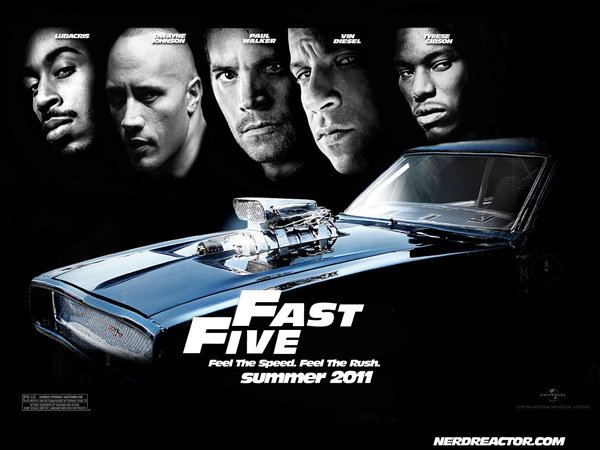
"Fast Five"
****
Ten years after the first Fast and the Furious movie one would think the franchise, at an average of one movie every two years, would be running out of gas. Bad pun intended. But this fifth outing, economically titled Fast Five, is not only the most successful of the franchise, it's arguably the best, if not necessarily the most flat-out entertaining. After a bravura opening involving three cars and a prison bus, the movie kind of lags a bit. But it's what it does during this unusual (for a "F & F" movie) down time is also what sets it apart from the rest: it dares to attempt some actual character building. Dom Toretto (Vin Diesel), Brian O'Conner (Paul Walker), and Mia Toretto (Jordana Brewster) come across as real people for the first time in the series. Dwayne Johnson joins the fray as federal agent Luke Hobbs, who makes Tommy Lee Jones' agent in The Fugitive look like a do-nothing wuss of the highest order. Sexy Elena Neves (Elsa Pataky), apparently the only non-corrupt cop in all of Brazil, joins Hobbs to track down Toretto and Co. The rest of the characters are one note, including the villain, but mostly lots of fun.
The introduction of most of these secondary characters (including several from previous "F & F" movies) as the new crew is rather amusing, and marks the turning point where the movie slips into a higher gear and starts delivering up the action and the humor in ample doses. After setting up a street race and then daring to have it occur off screen (gasp!), the movie more than makes up with a "just-for-kicks" drag race in police cars that is loads of fun and, right at the end, suddenly contributes once again to character. Hobbs and Toretto share one of the most bad ass Mano-a-Mano brawls I've seen in a good long time, even if it does end somewhat disappointingly. And it all leads up to one of the most wildly ridiculous but incredibly entertaining chase scenes ever, involving two sports cars, possibly hundreds of cops (all supposedly corrupt), and a dragging, several ton safe. Did I mention it was ridiculous?
Don't let my comments about character building fool you, ultimately the movie is as silly and irrelevant as the rest. But unlike the rest, it bothers to lay a little groundwork before pelting the mindless action at you. And for that, it earns a little more respect.
Post Script: stay tuned when the credits start; a final scene is tucked into them that not only sets up the inevitable F & F 6, but throws in a delightful twist!
Ten years after the first Fast and the Furious movie one would think the franchise, at an average of one movie every two years, would be running out of gas. Bad pun intended. But this fifth outing, economically titled Fast Five, is not only the most successful of the franchise, it's arguably the best, if not necessarily the most flat-out entertaining. After a bravura opening involving three cars and a prison bus, the movie kind of lags a bit. But it's what it does during this unusual (for a "F & F" movie) down time is also what sets it apart from the rest: it dares to attempt some actual character building. Dom Toretto (Vin Diesel), Brian O'Conner (Paul Walker), and Mia Toretto (Jordana Brewster) come across as real people for the first time in the series. Dwayne Johnson joins the fray as federal agent Luke Hobbs, who makes Tommy Lee Jones' agent in The Fugitive look like a do-nothing wuss of the highest order. Sexy Elena Neves (Elsa Pataky), apparently the only non-corrupt cop in all of Brazil, joins Hobbs to track down Toretto and Co. The rest of the characters are one note, including the villain, but mostly lots of fun.
The introduction of most of these secondary characters (including several from previous "F & F" movies) as the new crew is rather amusing, and marks the turning point where the movie slips into a higher gear and starts delivering up the action and the humor in ample doses. After setting up a street race and then daring to have it occur off screen (gasp!), the movie more than makes up with a "just-for-kicks" drag race in police cars that is loads of fun and, right at the end, suddenly contributes once again to character. Hobbs and Toretto share one of the most bad ass Mano-a-Mano brawls I've seen in a good long time, even if it does end somewhat disappointingly. And it all leads up to one of the most wildly ridiculous but incredibly entertaining chase scenes ever, involving two sports cars, possibly hundreds of cops (all supposedly corrupt), and a dragging, several ton safe. Did I mention it was ridiculous?
Don't let my comments about character building fool you, ultimately the movie is as silly and irrelevant as the rest. But unlike the rest, it bothers to lay a little groundwork before pelting the mindless action at you. And for that, it earns a little more respect.
Post Script: stay tuned when the credits start; a final scene is tucked into them that not only sets up the inevitable F & F 6, but throws in a delightful twist!
Wednesday, January 11, 2012
"Summer Wars"
*****
I honestly don't know if Anime has changed, or if I have. I once would have told you I did not like it; that I found it visually simplistic with jarring color flashes and god-awful voice work. But here, now, we have the fifth Anime movie in a row to which I've given 5 stars. (Following Grave of the Fireflies, Tales from Earthsea, Howl's Moving Castle, and Ponyo. All fantastic movies and well worth a look.)
This is a sci-fi/romance/comedy/family drama/action movie. Yeah. And it pulls off all these elements wonderfully. Set in what I imagine is a not-too-distant future (the film never specifies), Summer Wars imagines a world where much of the technologically advanced world has joined an uber-social network called Oz. The movie opens with a sort of commercial for Oz, familiarizing us with this virtual space, that is nothing like Facebook. There they can play games, access endless resources, buy things (for the real or virtual world), or even work. In fact most people have linked Oz directly to their jobs, so they can just work from home. People have customized avatars in this virtual space, and their avatars have digital access to everything they choose. Hence some avatars would have government access, some access to power and water facilities, some access to satellites in space. They do it all in Oz.
Young math genius Kenji actually works for Oz, writing code. He also has a crush on the pretty Natuski. And when Natuski asks him to come to her hometown for the summer to do a job for her, he agrees immediately. We meet Natuski's family, an enormous group of interesting folks, many of them cops or firefighters, lead by a matriarch nearing her 90th birthday. She's one of the best characters: a very strong old woman with a long lifetime of wisdom and resources, a quick wit, and a quicker temper. Just after arriving, Kenji gets a message from Oz, with a long number sequence and the words "solve me." Kenji, who as all math geniuses seem to be is slightly obsessive, solves the problem after a few frantic hours work. He has no idea that he's just unleashed what is essentially an artificially intelligent virus unto Oz. Overnight, havoc is wreaked on public works systems, financial systems, lighting grids, everything; because everything is wired in. Then the virus (hilariously called "Love Machine" by its inventor) begins consuming other avatars. And gaining their access. It should come as no surprise that it's going to come down to Kenji, Natuski, and the entire family to save not just the virtual world, but the real world as well.
At times this movie is visually stunning. Do not be put off by the cutesy image on the poster up there. There are some cutesy elements, yes, but as a whole I think this:
is far more representative of the look and feel of the movie. The virtual space is visualized brilliantly through one of the best blends of hand drawn and computer animation I've seen. And a moment comes towards the end that echos Chernabog during his "Night on Bald Mountain" in the seminal Fantasia. This gave me chills. But beyond the visual, the movie is often hilarious, occasionally thrilling, very smart, and more than a little touching. It's got heart to spare, and it's dead on in it's representation of a large but close knit family. And of course it is somewhat unsettling. How far are we from Oz, or something very like it? Not far I'd say. Not far at all.
I honestly don't know if Anime has changed, or if I have. I once would have told you I did not like it; that I found it visually simplistic with jarring color flashes and god-awful voice work. But here, now, we have the fifth Anime movie in a row to which I've given 5 stars. (Following Grave of the Fireflies, Tales from Earthsea, Howl's Moving Castle, and Ponyo. All fantastic movies and well worth a look.)
This is a sci-fi/romance/comedy/family drama/action movie. Yeah. And it pulls off all these elements wonderfully. Set in what I imagine is a not-too-distant future (the film never specifies), Summer Wars imagines a world where much of the technologically advanced world has joined an uber-social network called Oz. The movie opens with a sort of commercial for Oz, familiarizing us with this virtual space, that is nothing like Facebook. There they can play games, access endless resources, buy things (for the real or virtual world), or even work. In fact most people have linked Oz directly to their jobs, so they can just work from home. People have customized avatars in this virtual space, and their avatars have digital access to everything they choose. Hence some avatars would have government access, some access to power and water facilities, some access to satellites in space. They do it all in Oz.
Young math genius Kenji actually works for Oz, writing code. He also has a crush on the pretty Natuski. And when Natuski asks him to come to her hometown for the summer to do a job for her, he agrees immediately. We meet Natuski's family, an enormous group of interesting folks, many of them cops or firefighters, lead by a matriarch nearing her 90th birthday. She's one of the best characters: a very strong old woman with a long lifetime of wisdom and resources, a quick wit, and a quicker temper. Just after arriving, Kenji gets a message from Oz, with a long number sequence and the words "solve me." Kenji, who as all math geniuses seem to be is slightly obsessive, solves the problem after a few frantic hours work. He has no idea that he's just unleashed what is essentially an artificially intelligent virus unto Oz. Overnight, havoc is wreaked on public works systems, financial systems, lighting grids, everything; because everything is wired in. Then the virus (hilariously called "Love Machine" by its inventor) begins consuming other avatars. And gaining their access. It should come as no surprise that it's going to come down to Kenji, Natuski, and the entire family to save not just the virtual world, but the real world as well.
At times this movie is visually stunning. Do not be put off by the cutesy image on the poster up there. There are some cutesy elements, yes, but as a whole I think this:
Sunday, January 8, 2012
"Mission Impossible: Ghost Protocol"
*****
Early on in this movie, Ethan Hunt (Tom Cruise) receives the specs of his new mission from a little screen that pops out of a pay telephone somewhere in Russia. At the end we hear the now famous line, "This message will self destruct in 5 seconds," followed by a timer appearing on the screen. Hunt hangs up the phone, the screen retracts within, he starts to walk away and... nothing happens. Hunt turns back to the payphone and hits it, the oldest standby for making faulty gadgets work. And of course it works here, producing a sizzling sound and a puff of smoke from within the phone. This moment is very funny, one of many great laugh-out-loud moments in the film; but it is also the first in a long series of malfunctions with the tech used by the agents. Of course these malfunctions lead to some serious problems, and it's up to Hunt and his crew to resolve these problems personally. A theme has emerged: in the heat of the moment, you must rely on the people you trust to get the job done.
This is just one of many smaller themes running beneath the surface of this movie, and one of the many reasons I loved it so much! Director Brad Bird, arguably one of the greatest animation directors working today (The Incredibles, Ratatouille, The Iron Giant), has delivered his first live-action movie with as much humor, as much pulse pounding, kinetic action, and as much intelligence as he puts into animation, if not quite as much heart. Among the spectacular action set-pieces presented here is a chase through an enormous dust storm, a fight through several levels of an automated parking structure, and an attempt to scale and then descend a portion of the world's tallest building that, of course, does not go quite as planned. This last scene is an excellent reminder that the depth of 3D is not required for a movie to induce an enormous sense of vertigo. I should also make note that the movie is shot and edited in a very clean and straightforward way, and makes no use of the rapid editing and shaking, wobbly camera work that some directors (I'm looking at you, Tony Scott) seem to think is required for action. This is a breath of fresh air.
The cast is superb. Cruise has been playing this character for something like 12 years now, so he slips into it like a glove. Paula Patton is sexy and seductive, but can kick ass with the best of them, and carries a touch of grief with her through most of the movie (for reasons that become very clear in the early moments). Simon Peg is Simon Peg, and for the purposes of his role as tech man and first time field agent Benji Dunn, he need not be more; this man is living, walking comic relief. Jeremy Renner, as seems to be becoming his trademark, is better than he needs to be. As William Brandt he is burdoned by guilt over a secret he is carrying, and in some ways the slow revelation of who he is and why he's so burdoned is the very element that elevates this from really good movie to great movie. It's a touch of that heart that Bird brings in such abundance to his animated features. (Incidentally, Renner's character will take over the series once Cruise decides to step down.) And Michael Nyqvist, probably best known for playing the Daniel Craig role in the original Swedish version of The Girl with the Dragon Tatoo and its sequels, plays Kurt Hendricks, the very best kind of villian. No mad schemes of power or wealth for him, rather a pure and righteous belief that what he's doing is the right thing. He not only seems ready to die for this belief but it looks to me as if he expects to.
I didn't care for the first Mission Impossible; I found it unnecesserily convoluted and more than a little silly. But every one that has come has improved upon the last. And here, now , with the fourth in the series, we have not only the best Mission yet, but also very likely the best straight-up action movie of 2011.
Early on in this movie, Ethan Hunt (Tom Cruise) receives the specs of his new mission from a little screen that pops out of a pay telephone somewhere in Russia. At the end we hear the now famous line, "This message will self destruct in 5 seconds," followed by a timer appearing on the screen. Hunt hangs up the phone, the screen retracts within, he starts to walk away and... nothing happens. Hunt turns back to the payphone and hits it, the oldest standby for making faulty gadgets work. And of course it works here, producing a sizzling sound and a puff of smoke from within the phone. This moment is very funny, one of many great laugh-out-loud moments in the film; but it is also the first in a long series of malfunctions with the tech used by the agents. Of course these malfunctions lead to some serious problems, and it's up to Hunt and his crew to resolve these problems personally. A theme has emerged: in the heat of the moment, you must rely on the people you trust to get the job done.
This is just one of many smaller themes running beneath the surface of this movie, and one of the many reasons I loved it so much! Director Brad Bird, arguably one of the greatest animation directors working today (The Incredibles, Ratatouille, The Iron Giant), has delivered his first live-action movie with as much humor, as much pulse pounding, kinetic action, and as much intelligence as he puts into animation, if not quite as much heart. Among the spectacular action set-pieces presented here is a chase through an enormous dust storm, a fight through several levels of an automated parking structure, and an attempt to scale and then descend a portion of the world's tallest building that, of course, does not go quite as planned. This last scene is an excellent reminder that the depth of 3D is not required for a movie to induce an enormous sense of vertigo. I should also make note that the movie is shot and edited in a very clean and straightforward way, and makes no use of the rapid editing and shaking, wobbly camera work that some directors (I'm looking at you, Tony Scott) seem to think is required for action. This is a breath of fresh air.
The cast is superb. Cruise has been playing this character for something like 12 years now, so he slips into it like a glove. Paula Patton is sexy and seductive, but can kick ass with the best of them, and carries a touch of grief with her through most of the movie (for reasons that become very clear in the early moments). Simon Peg is Simon Peg, and for the purposes of his role as tech man and first time field agent Benji Dunn, he need not be more; this man is living, walking comic relief. Jeremy Renner, as seems to be becoming his trademark, is better than he needs to be. As William Brandt he is burdoned by guilt over a secret he is carrying, and in some ways the slow revelation of who he is and why he's so burdoned is the very element that elevates this from really good movie to great movie. It's a touch of that heart that Bird brings in such abundance to his animated features. (Incidentally, Renner's character will take over the series once Cruise decides to step down.) And Michael Nyqvist, probably best known for playing the Daniel Craig role in the original Swedish version of The Girl with the Dragon Tatoo and its sequels, plays Kurt Hendricks, the very best kind of villian. No mad schemes of power or wealth for him, rather a pure and righteous belief that what he's doing is the right thing. He not only seems ready to die for this belief but it looks to me as if he expects to.
I didn't care for the first Mission Impossible; I found it unnecesserily convoluted and more than a little silly. But every one that has come has improved upon the last. And here, now , with the fourth in the series, we have not only the best Mission yet, but also very likely the best straight-up action movie of 2011.
"Contagion"
****½
This is the most un-sensational epidemic movie I've ever seen, and that's a compliment. It is so grounded in reality, so meticulous with it's scientific detail, that it steps ahead of the vast majority of other entries into it's genre. This could happen tomorrow.
Director Steven Soderbergh uses vast, multi-character plot lines to portray many different aspects of a pandemic, from scientists racing to identify the virus, trace it's origin, and create a vaccine; to panic stricken people doing whatever they can (even if they shouldn't) to survive; to an average American family devastated by quick, unexpected loss; to conspiracy theorists who see the whole thing as a profiteering scheme by pharmaceutical companies. Unlike many multi-character plots I've seen, every thread here works, and contributes to the greater whole of the story as well as having many thought provoking, subtle and not so subtle meanings hidden underneath.
The methods Soderbergh uses to follow the virus are ingenious in their simplicity. Never before while watching a movie have I been so aware of what people are touching. And where. And how often. And just how dire the consequences of a simple thing like a friendly handshake could be. I should note that if you're looking for an edge-of-your-seat thriller you should look elsewhere; this is not that movie, there are very few actual "thrills" here. But if you're searching for a well thought out, sober drama deeply exploring the implications of a global horror that will leave you with lingering concerns long after you finish watching, here you have your grim, unsettling, wonderful reward.
This is the most un-sensational epidemic movie I've ever seen, and that's a compliment. It is so grounded in reality, so meticulous with it's scientific detail, that it steps ahead of the vast majority of other entries into it's genre. This could happen tomorrow.
Director Steven Soderbergh uses vast, multi-character plot lines to portray many different aspects of a pandemic, from scientists racing to identify the virus, trace it's origin, and create a vaccine; to panic stricken people doing whatever they can (even if they shouldn't) to survive; to an average American family devastated by quick, unexpected loss; to conspiracy theorists who see the whole thing as a profiteering scheme by pharmaceutical companies. Unlike many multi-character plots I've seen, every thread here works, and contributes to the greater whole of the story as well as having many thought provoking, subtle and not so subtle meanings hidden underneath.
The methods Soderbergh uses to follow the virus are ingenious in their simplicity. Never before while watching a movie have I been so aware of what people are touching. And where. And how often. And just how dire the consequences of a simple thing like a friendly handshake could be. I should note that if you're looking for an edge-of-your-seat thriller you should look elsewhere; this is not that movie, there are very few actual "thrills" here. But if you're searching for a well thought out, sober drama deeply exploring the implications of a global horror that will leave you with lingering concerns long after you finish watching, here you have your grim, unsettling, wonderful reward.
Subscribe to:
Posts (Atom)